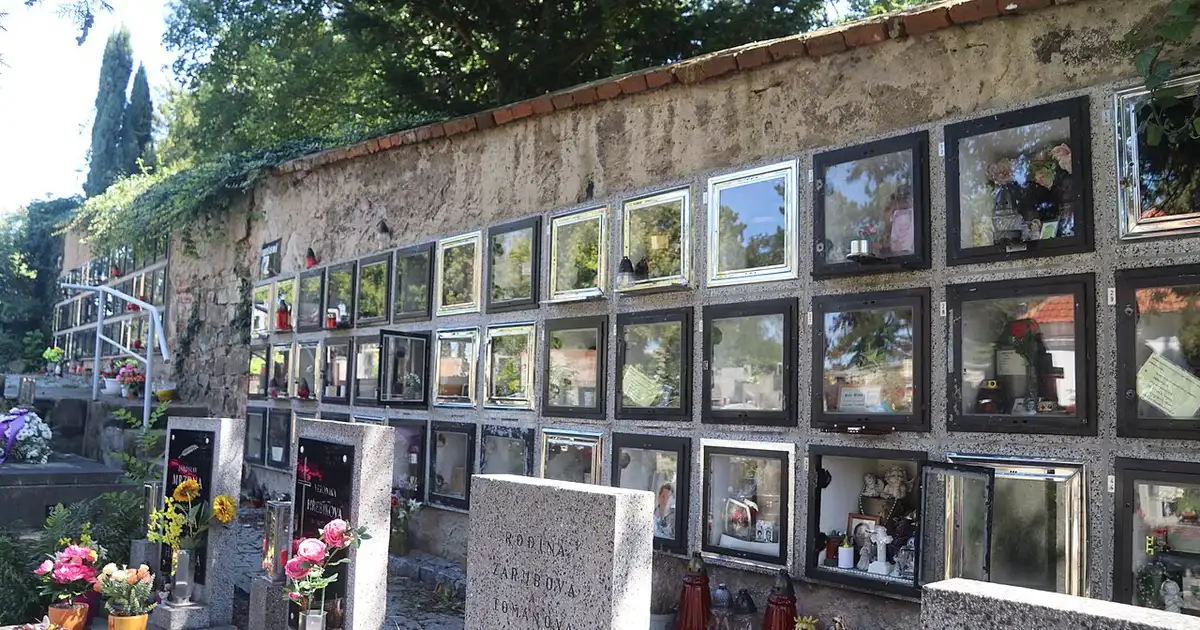
Introduction
We understand that you are going through one of the most difficult periods of your life. The loss of a loved one brings pain and confusion — and making decisions about the funeral at such a time can feel overwhelming. If you are considering cremation without a ceremony, know that you are not alone. In the Czech Republic, this is the most commonly chosen form of farewell, and your decision deserves respect.
Cremation without a ceremony — sometimes referred to as a "quiet cremation" (tichá kremace) or "zpopelnění bez obřadu" — means that the cremation itself takes place without a public memorial gathering. However, this does not mean a farewell without respect. On the contrary: many families choose it precisely so they have the time and space to say goodbye in their own way, without the pressure of a formal ceremony.
In this article, we will clearly explain what cremation without a ceremony involves, how the entire process works step by step, what costs to expect in 2026, what the advantages and drawbacks are, and what you can do with the ashes after cremation. If you need a general overview of funeral organisation, we also recommend our guide to organising a funeral in the Czech Republic.
Whether you are choosing cremation without a ceremony for practical, financial, or personal reasons — this article is here for you. There is no "right" or "wrong" way to say goodbye. What matters is that it suits your needs and the wishes of your family.
What Is Cremation Without a Ceremony and Why Is It So Common in the Czech Republic
Cremation without a ceremony is a form of funeral in which the body of the deceased is cremated without a public memorial gathering. In the Czech Republic, up to 70% of families choose this option, making it the dominant form of farewell. Experts in funeral culture describe this phenomenon as a "Czech speciality" — in no other European country is cremation without a ceremony so widespread.
Why the Czech Republic Is Exceptional
The Czech Republic holds one of the highest cremation rates in the world — approximately 85% of all funerals take the form of cremation. But what is even more remarkable: the vast majority of these cremations take place without any public ceremony.
The roots of this trend go back to the 1990s, when societal expectations began to shift after the fall of communism. Factors that contributed:
- Secularism — approximately 78% of the Czech population does not identify with any religious denomination, which significantly reduces demand for religious ceremonies.
- Pragmatism — Czech bereaved families often prioritise practical solutions over formal ceremonies.
- Lower costs — cremation without a ceremony is the most affordable funeral option.
- Privacy — many families prefer an intimate farewell in a small circle rather than a public ceremony.
Regional Differences
The proportion of cremations without a ceremony varies significantly by region. According to estimates from funeral services, in Prague it reaches 80–90%, whilst in South Moravia — where there is a stronger cultural tradition of ceremonial farewell — it stands at around 40%. The average across the entire Czech Republic is approximately 70%.
Comparison of Funeral Types
| Criterion | Cremation without ceremony | Cremation with ceremony | Earth burial |
|---|---|---|---|
| Process | Cremation without public gathering | Memorial ceremony + cremation | Ceremony + coffin burial in a grave |
| Approximate cost | 10,000–22,000 Kč | 22,000–45,000 Kč | 45,000–90,000 Kč |
| Processing time | 2–3 weeks | 1–2 weeks (incl. ceremony) | 5–10 days |
| Attendance of bereaved | No (at the cremation itself) | Yes (memorial hall) | Yes (cemetery) |
| Grave costs | No (optional) | No (optional) | Yes (mandatory) |
| Share in the Czech Republic | ~70% | ~15% | ~15% |
As the comparison shows, cremation without a ceremony is by far the most common choice in the Czech Republic. If you are interested in a detailed comparison of the costs of all funeral types, read our article How Much Does a Funeral Cost in the Czech Republic in 2026.
How Cremation Without a Ceremony Works — Step by Step
The entire process of cremation without a ceremony involves several clearly sequential steps: you contact the funeral service, submit documents, select an urn, and within 2–3 weeks you collect the ashes. The cremation itself takes place at a temperature of 750–850 °C and lasts approximately 60–90 minutes. The bereaved are not present during the cremation.
Step 1: Contact a Funeral Service
The first step is to approach a funeral service that will handle the entire process. The funeral service can be contacted by telephone — most of them operate around the clock, 24 hours a day. Inform them that you wish to have a cremation without a ceremony.
Step 2: Submit the Required Documents
The following documents need to be provided to the funeral service:
- List o prohlídce zemřelého (Medical certificate of death) — issued by the doctor who examined the body.
- Občanský průkaz zemřelého (Deceased's identity card) (if available).
- Your identity documents — as the person ordering the funeral.
- Any wishes of the deceased — if there is a written expression of will (testament, contract with a funeral service).
A detailed overview of all required documents can be found in the article What to Do When Someone Dies.
Step 3: Selecting an Urn
The funeral service will offer you a catalogue of urns. You can choose from a wide range of materials and price categories — from basic plastic to ceramic, wooden, stone, or brass. You can also purchase an urn independently. If you do not select an urn, a standard urn included in the service price will be used.
Step 4: Transport of the Body
The funeral service arranges the transport of the deceased's body from the place of death (hospital, home, social care facility) to a cold storage facility and subsequently to the crematorium. Act No. 256/2001 Sb. (Funeral Services Act) requires that the body be placed in a coffin before cremation — even for cremation without a ceremony, a cremation coffin is used.
Step 5: The Cremation Itself
The cremation takes place in a cremation furnace at a temperature of 750–850 °C. The entire process lasts approximately 60–90 minutes. Each cremated body is marked with an identification tag (a metal disc with a number) that is placed in the furnace together with the coffin. This tag ensures that the ashes are always correctly assigned to the specific deceased.
Step 6: Collecting the Urn
After cremation, the ashes are placed in the selected urn. The urn is typically ready for collection 2 to 3 weeks after the death. The crematorium or funeral service will contact you once the urn is ready. You can collect the urn in person or request delivery to an agreed address.
Timeline of the Entire Process
| Step | Usual timeframe |
|---|---|
| Contact with the funeral service | Immediately after death |
| Submission of documents | 1–2 days |
| Transport of the body to the crematorium | 1–3 days |
| Cremation | Within 1 week of receiving documents |
| Preparation of the urn | 1–2 weeks after cremation |
| Total from death to collecting the urn | 2–3 weeks |
The Funeral Services Act stipulates that within 96 hours of notification of death, the intention to arrange a funeral must be expressed. This deadline is important — if nobody arranges the funeral, the obligation falls to the municipality.
How Much Does Cremation Without a Ceremony Cost in 2026
The total cost of cremation without a ceremony in the Czech Republic in 2026 ranges from 10,000 to 22,000 Kč, depending on the region, the chosen funeral service, and the type of urn. This is the most affordable form of funeral in the Czech Republic. The price typically includes transport of the body, storage in a cold facility, cremation, and a basic urn.
Breakdown of Individual Items
| Item | Price range (Kč) | Note |
|---|---|---|
| Transport of the body (up to 50 km) | 2,000–5,000 | Additional charges per further km |
| Storage in a cold facility | 500–2,000 | Depends on the number of days |
| Cremation coffin | 1,000–3,000 | Legal requirement, even without a ceremony |
| Cremation | 4,000–8,000 | Crematorium fee |
| Urn (basic) | 500–3,000 | Plastic 500–1,000, ceramic 1,500–3,000 |
| Administrative fees and documents | 500–1,500 | Issuance of death certificate, etc. |
| Dressing of the deceased | 0–1,500 | Some services charge separately |
| Total | 10,000–22,000 | Excluding grave plot and gravestone |
Prices by Region
Prices for cremation without a ceremony in the Czech Republic vary by city and region. The highest prices are traditionally in Prague, where funeral services have higher operating costs.
| City / region | Approximate cost (Kč) | Note |
|---|---|---|
| Prague | 15,000–22,000 | Highest prices in the Czech Republic |
| Brno | 12,000–18,000 | Mid-range prices |
| Ostrava | 11,000–16,000 | Slightly below average |
| Liberec | 10,000–15,000 | Lower price range |
| Ústí nad Labem | 12,000–17,000 | Comparable to Brno |
| Plzeň | 12,000–17,000 | Mid-range prices |
| Smaller towns | 10,000–14,000 | Generally the lowest prices |
Note: Prices are approximate and current as of March 2026. Specific amounts may vary depending on the funeral service. We recommend requesting a quote from at least two funeral services and comparing the items.
How to Save (and Where Not To)
- Compare quotes — prices of funeral services can differ by thousands of Kč for the same service.
- Ask about the funeral allowance — if you are entitled to the state funeral allowance of 5,000 Kč, it can cover part of the costs. Details in the article Funeral Allowance — How to Apply.
- Do not economise on dignity — even with the most affordable option, it is important that the entire process is conducted with respect for the deceased.
Cremation Without a Ceremony — Advantages and Disadvantages
Cremation without a ceremony has a number of practical advantages — it is affordable, quick, and allows for a private farewell without time pressure. At the same time, it is necessary to consider some disadvantages, such as the impossibility of a public farewell at the actual funeral. For most Czech families, however, the advantages outweigh the drawbacks, as evidenced by the 70% share choosing this option.
Overview of Advantages and Disadvantages
| Advantages | Disadvantages |
|---|---|
| Lowest cost of all funeral types | The bereaved are not present during cremation |
| No need to organise a ceremony under time pressure | For some, a formal "farewell" may be missed |
| Privacy — farewell in your own time and form | Friends and colleagues may not have an opportunity to express condolences |
| Less administration and logistics | In more traditional communities, it may be misunderstood |
| Option to organise your own memorial gathering later | Not suitable if the deceased expressly wished for a public ceremony |
| No need to arrange a ceremonial hall, bouquets, or music | — |
| The urn can be kept at home (legal in the Czech Republic) | — |
Stigma? Not in the Czech Republic
In some countries, cremation without a ceremony may be perceived as a "cheaper" or "less dignified" alternative. In the Czech Republic, this is not the case. With a share of around 70%, it is clearly the primary way Czech families bid farewell to their loved ones. Choosing cremation without a ceremony is not a sign of a lack of love — it is a conscious decision that respects the practical and emotional needs of the family.
A Private Farewell as an Alternative
Many families who choose cremation without a ceremony later organise their own memorial gathering — at home, in a restaurant, in nature, or at another place the deceased was fond of. Such a farewell can take place at any time — a week, a month, or on an anniversary. Nobody is forcing you to say goodbye "by the rules".
Without a ceremony does not mean without memories. Create a digital memorial page where family and friends can add photographs and stories. Create a memorial on Kinmory
What to Do With the Ashes After Cremation
In the Czech Republic, the handling of ashes after cremation is very liberal — Act No. 256/2001 Sb. on Funeral Services allows you to keep the urn with ashes at home, inter it in a cemetery, place it in a columbarium, scatter the ashes at a designated scattering lawn, or in an urn grove. Unlike Germany, where the strict Friedhofszwang (obligation to inter remains in a cemetery) applies, in the Czech Republic the person who arranged the funeral decides the fate of the ashes.
Options for Placing the Ashes
| Option | Description | Approximate costs |
|---|---|---|
| Keeping at home | Urn in a dignified place in the home | 0 Kč (only the urn price) |
| Cemetery — urn grave | Placing the urn in a grave at the cemetery | Prague approx. 351 Kč/year per 1 m² (rental and services, category I); Brno 155 Kč/m²/year; Ostrava 166 Kč/m²/year |
| Columbarium | Urn niche in a wall or building | Prague 1,630–8,970 Kč per 10 years; Brno 3,650–7,300 Kč per 10 years; Ostrava 902 Kč/year |
| Scattering lawn | Scattering the ashes on a designated area of the cemetery | 1,000–5,000 Kč (one-off) |
| Urn grove | Placing the urn underground in a park section of the cemetery | Prague (Strašnice, Motol) approx. 465 Kč/year per 1 m² (rental 134 Kč + services 331 Kč) |
| Scattering in nature | Scattering the ashes in nature (with the landowner's consent) | 0 Kč |
Cemetery prices are examples from official price lists: Prague — Hřbitovy a pohřební služby hl. m. Prahy, price list valid from 1 July 2026; Brno — Správa hřbitovů města Brna, rental prices from 1 January 2024; Ostrava — Slezská Ostrava district, price list from 1 March 2024. There is no national price list; each cemetery sets its own prices.
Legal Framework
Under Section 14(3)(h) of Act No. 256/2001 Sb. on Funeral Services, the crematorium invites the funeral arranger (vypravitel pohřbu) or the funeral service to collect the urn and hands it over to them; if nobody collects it within 12 months of the cremation, the crematorium is required to place the ashes in a common grave at a public cemetery. After receiving the urn, responsibility for the dignified handling of the ashes passes to the person who ordered the funeral. The law does not prescribe a mandatory place of interment — unlike most European countries.
If you decide to keep the urn at home, please bear in mind that it is advisable to inform your closest family of the place of storage. In the event of your own death, it should be clear where the urn is located and how to handle it.
A detailed overview of grave plot options and their prices can be found in the article Grave Plot — Cost and Rental.
If you do not have a physical place to visit, a digital memorial can serve as a lasting place of remembrance — accessible from your phone anywhere.
Frequently Asked Questions
Is cremation without a ceremony less dignified than a funeral with a ceremony?
No, cremation without a ceremony is not less dignified. In the Czech Republic, up to 70% of families choose it, and it is a fully respected form of farewell. Dignity does not lie in the ceremony but in the respect shown to the deceased. A farewell gathering can also be organised later, in your own way and in your own time. No law or social norm says that a farewell without a public ceremony is less valuable.
Can I keep the ashes at home, or is it illegal?
In the Czech Republic, keeping an urn with ashes at home is entirely legal. Unlike Germany, where Friedhofszwang (the obligation to inter remains in a cemetery) applies, in the Czech Republic the person who arranged the funeral decides where to place the ashes. Act No. 256/2001 Sb. does not prescribe a mandatory place of interment. You can keep the urn at home, inter it in a cemetery, place it in a columbarium, or scatter the ashes at a designated scattering lawn.
How long does the entire process take from death to collecting the urn?
The entire process from death to collecting the urn typically takes 2 to 3 weeks. The cremation itself takes place within a few days of submitting the documents. The urn is then ready for collection at the crematorium, or the funeral service can deliver it to an agreed location. The legal deadline requires the intention to arrange a funeral to be expressed within 96 hours of notification of death.
Can I choose the urn myself, or does the funeral service provide it?
Yes, you can choose the urn yourself. Funeral services offer a catalogue of urns in various materials and price ranges — from basic plastic ones (500–1,000 Kč) to ceramic, wooden, or brass ones (2,000–10,000 Kč). You can also purchase an urn independently, for example from online shops specialising in funeral supplies. If you do not select an urn, a standard urn included in the service price will be used.
Cremation without a ceremony — can I organise a farewell later?
Of course. Many families choose cremation without a ceremony precisely to gain time to prepare their own farewell. You can organise a private gathering at home, in nature, or in a rented venue — without time pressure and exactly according to your wishes. Some families hold a memorial gathering on the first anniversary, whilst others prefer an intimate farewell in a small circle within a few weeks.
Summary
- Cremation without a ceremony is the most common form of funeral in the Czech Republic — approximately 70% of families choose it.
- The cost in 2026 ranges from 10,000 to 22,000 Kč, depending on the region and scope of services.
- The process involves contacting a funeral service, submitting documents, cremation, and collecting the urn — everything typically takes 2–3 weeks.
- In the Czech Republic, keeping the urn at home is entirely legal — the person who arranged the funeral decides where to place the ashes.
- Cremation without a ceremony is not less dignified — it is a conscious decision respecting the family's needs.
- A farewell can be organised at any time later — at home, in nature, or at another place meaningful to the deceased.
- If you are entitled to the state funeral allowance (5,000 Kč), it can cover part of the costs.
- Compare quotes from at least two funeral services — prices can differ significantly.
Related Articles
- Cremation in the Czech Republic — Complete Guide to Cremation — a detailed overview of the entire cremation process, including cremation with a ceremony.
- How Much Does a Funeral Cost in the Czech Republic in 2026 — a comparison of costs for all funeral types.
- How to Arrange a Funeral in the Czech Republic — Step by Step — a complete guide to organising a funeral.
- Grave Plot — Cost and Rental — an overview of grave plot prices and urn interment options.
- How to Choose a Funeral Service — what to ask and what to avoid.
A Memory Can Be Preserved Even Without a Traditional Gravestone
If you have chosen cremation without a ceremony, you do not need a grave plot or a gravestone to preserve the memory of your loved one. A digital memorial is a lasting place where family and friends from all over the world can add photographs, stories, and memories — without time limits and without grave plot rental fees.