This article was prepared by the Kinmory team, which owns Ohnik. We share practical advice for a family archive and explain how our service can help preserve memories.
Introduction
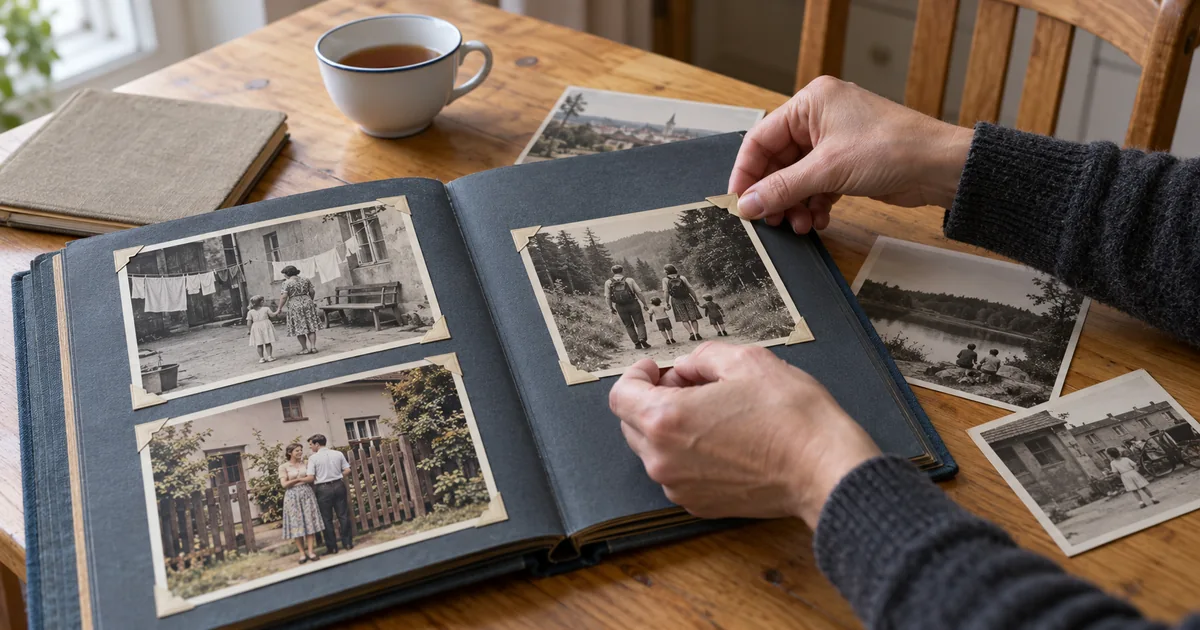
Looking through old photographs after losing someone close can be hard. Choose only what you can manage today, and stop whenever you need to. Writing a family history in the Czech Republic can begin modestly: with one album, a few captions and a short conversation with a grandmother or grandfather. It need not be complete or perfectly written.
Write down who is in the picture, where and roughly when it was taken, and why it matters to the family. You do not need every date or a biography of every ancestor. Mark uncertain details with a question mark.
A family history, known in Czech as a rodinná kronika (family chronicle), records who belonged to the family, where they lived and what they went through. The family archive is the material it draws on. This guide is for families who live in the Czech Republic or trace Czech roots from abroad and want to keep older relatives’ stories for their children and grandchildren. It covers what to include, how to label and digitise photographs, what Czech law says about municipal chronicles, parish and civil registers (matriky) and consent, and where to keep it all.
Everything essential can be done at home with a pencil, paper and a phone, without any online service. A family history can grow chapter by chapter, and each step is worthwhile on its own. If you need support while grieving, our article How to cope with grief may help.
What Belongs in a Family History
A family history brings together names, dates, family relationships, older relatives’ stories, labelled photographs, letters, documents and places where the family lived. It should make sense to someone who never met these people, so for every item, note who, where and when.
| What to keep | How | What it gives the family |
|---|---|---|
| Names, dates, family relationships | A family tree on paper, uncertain details marked with a question mark | An overview of who is who |
| Life stories | Written in the storyteller’s words, noting the date of the conversation | Context that documents lack |
| Photographs | A caption: who, where, when and according to whom | Faces get names |
| Letters, diaries, postcards | In folders, with a list of who wrote each one | The writers’ own words |
| Documents | Copies in the family history, originals in a dry, dark place | Evidence for names and dates |
| Places | Addresses, former place names, details of the burial plot | Relatives know where to go |
Names were spelled in different ways, in families and documents alike. Note every variant side by side, such as a nickname, the original spelling and today’s form, and do not correct the family story on a guess.
A family history template: sample outline
- Introduction: who is writing the family history, and for whom.
- A family tree on a single page.
- A chapter on each generation: where people lived, how they earned a living, what they went through.
- Labelled photographs.
- Places: houses, villages and towns, cemeteries and burial plot numbers.
- Where the information comes from: conversations, documents, registers.
How to Write a Family History: Step by Step
Write a family history in small steps: choose one album, ask older relatives, label and digitise the photographs, write down the stories and draw a family tree. Then agree who keeps the originals and who holds the second copy. None of it has to happen in this order, or all at once.
1. Choose one album or one box
Start with a small part of the archive. Photograph the album pages or box contents as they are stored: even the order of the pictures can hint at connections. Number the prints in a list, for example “album 2, photo 014”, but do not write on them yet (step 3 covers labelling). Do not pull off stuck-down photographs, and ask a specialist about damaged material.
2. Ask about specific memories
Group the questions to ask grandparents by theme: where they grew up, what their parents did for a living, how they met, what was cooked at home and who is in which picture. Ask about particular events rather than dates, and let them tell it in their own words. Record a conversation only with the storyteller’s consent, and ask them to repeat unfamiliar names. If you can no longer ask the oldest relatives, try aunts, uncles, siblings or long-standing family friends. Each may remember a different piece of the story.
3. Label the photographs
For each photograph, note who is in it (left to right), where it was taken and roughly when. Add “according to Aunt Anna” to anything uncertain. A caption might read: “From left, Grandfather Josef, Grandmother Jiřina and Aunt Anna in front of the house in the family’s home village, around 1962, according to Aunt Anna.” Avoid writing on the front with a ballpoint or felt-tip pen, and keep captions in a separate numbered list. If you must mark a print itself, write as little as possible, in soft pencil on the back near the edge.
4. Digitise old photographs
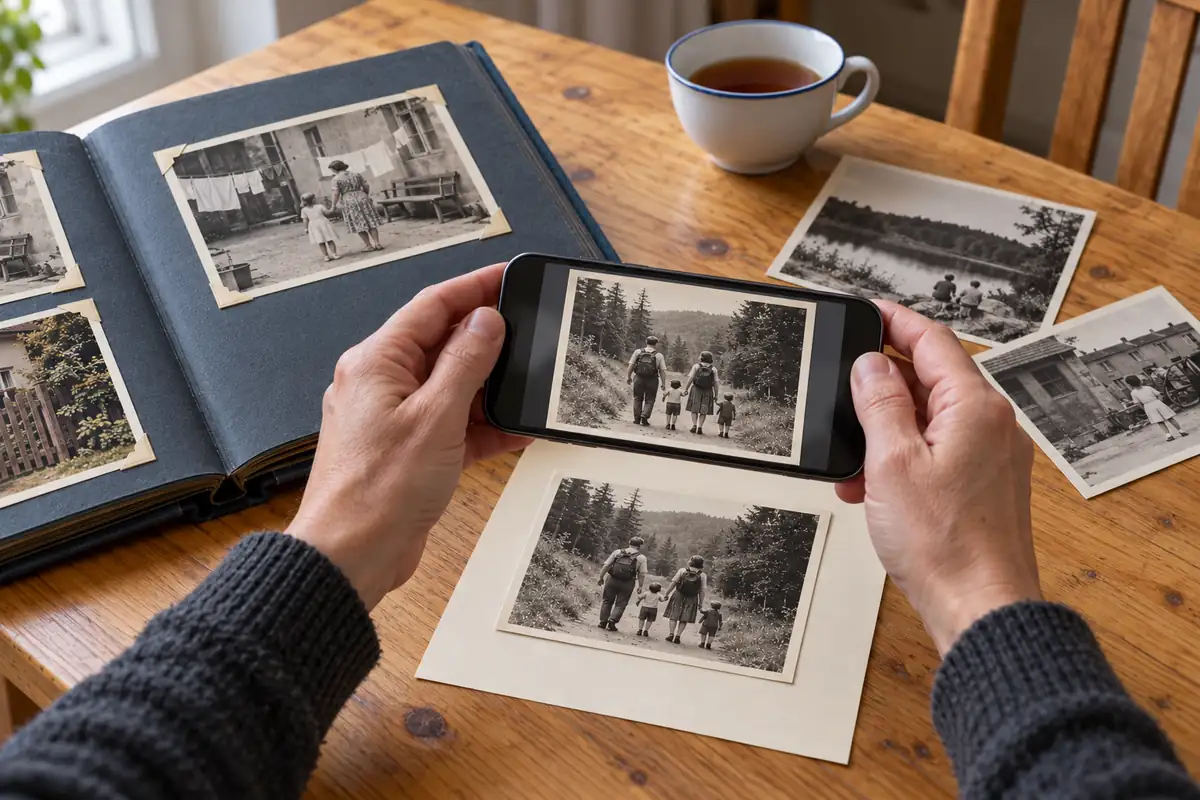
Digitising old photographs needs no special equipment. Scan flat, undamaged prints, or photograph them with a phone held parallel above the original, in even light, without glare or the shadow of your hands. Capture the whole print, and the back too if it carries a caption, a stamp or a date. Leave the original file uncropped, save an edited version under a different name, and name the files consistently, for example “1962-courtyard-grandmother-01”. Do not throw the originals away after digitising.
5. Write down the story and draw a family tree
Wondering how to build a family tree? On paper, start with yourself, add parents, grandparents and earlier generations, and join relatives with lines. Add years of birth and death, mark uncertain details with a question mark and write approximate dates in the form “around 1950”. Write the stories by period of life (for example childhood, school, work, family), in the storyteller’s own words.
6. Agree on copies and access
Agree who looks after the originals, who keeps the second copy and who writes the captions. Show photographs and details of living relatives to others only with their consent. Then ask another relative to find one particular photograph unaided. You will see where numbers or explanations are missing.
Family History in the Czech Republic: Municipal Chronicles, Registers and Consent
It helps to know about municipal chronicles, registers and consent. Anyone may consult a Czech municipal chronicle at the municipal office at set times. Many old registers can be viewed online. More recent entries may generally be inspected only by the people concerned and their family members. Photographs and private letters call for the consent of those involved.
The municipal chronicle
Every Czech municipality (obec) keeps a chronicle recording important and memorable local events “for the information and instruction of future generations” (§ 1 of Act No. 132/2006 Coll., our translation). Anyone may consult it at the municipal office (obecní úřad) at set times (§ 4), so check the times beforehand. A family history is the same idea on the scale of one family.
Czech registers online and who may inspect them
Archives make digitised registers available. The State Regional Archives in Prague (Státní oblastní archiv v Praze) offers registers from the Central Bohemian Region (not the city of Prague) in eBadatelna. The Moravian Land Archives in Brno (Moravský zemský archiv) offers registers from the former South Moravian Region in Acta Publica. For western Bohemia, the State Regional Archives in Plzeň (Státní oblastní archiv v Plzni) runs the Porta fontium portal. Other archives keep registers from other areas and publish them on their own websites. eBadatelna, for example, lists links to those websites.
Both eBadatelna and Acta Publica let you search by place, so first find out where the family came from. Old entries are mainly in Czech, German and Latin. The portals themselves work mainly in Czech: eBadatelna and Acta Publica also offer English and German versions (Acta Publica’s English version is only partly translated), and Porta fontium offers Czech and German.
More recent registers stay with registry offices (matriční úřady) for the period set by law. A registry office issues certificates to, or allows inspection by, the person an entry concerns and their family members: a spouse or partner in the legal sense, parents, children, siblings, grandparents, grandchildren and great-grandchildren. In some special cases, the law narrows this list.
The registry office makes an entry available to anyone else once 100 years (births), 75 years (marriages and registered partnerships) or 30 years (deaths) have passed since the entry was made. Inspection takes place in the presence of the registrar (§ 8a para. 6, § 25 and § 25b of Act No. 301/2000 Coll.). Check the procedure with the registry office beforehand.
Avoid publishing scans of registers. According to the terms of use of the Moravian Land Archives, digitised materials may not be placed on other websites or otherwise published without the written consent of the owner of the records. Transcribe the details faithfully and name the source. A register holds names and dates, while the stories and photographs stay with the family.
Consent, photographs and letters
Any person close to the deceased may seek protection of the deceased’s personality rights (§ 82 para. 2 of the Civil Code). So agree within the family before showing the deceased’s story and photographs outside it.
Ask living people for their consent. As a rule, a likeness may be captured and shared only with the person’s consent (§ 84, § 85 para. 1), and consent can be withdrawn even if it was given for a limited period (§ 87 para. 1). Private writings of a personal nature, such as letters or diaries, are protected to the same extent as records of private life (§ 86). This is general information, not legal advice.
When to talk about the past
There are plenty of occasions to talk, such as Den rodin (Family Day) on 15 May or Dušičky, All Souls’ Day on 2 November. There is no need to hurry. One question, and time to answer it, is enough.
Where to Keep a Family History
Keep your family history in at least two places, chosen according to who should have access. A paper album, files on a home drive, a shared family drive and an online page each have their uses. A combination works best: paper at home, files elsewhere.
| Method | Who has access | Best for | How to look after it |
|---|---|---|---|
| Paper album and folder | Whoever has them at home | Looking through the pictures together | Store in a dry, dark place, without clips or sticky tape |
| Files on a home drive | The drive’s owner and people with a copy | Keeping original files of photographs and documents | Keep a second copy on another drive |
| Shared family drive | People given access rights | Collecting material from relatives | Agree on folder names, access and a backup |
| Page on a social network | The audience chosen in the settings | Sharing individual memories | Keep the originals in the family archive too |
| A dedicated memorial page | Visitors, depending on the chosen mode | Combining photographs, a story and the memories of loved ones | Keep the originals and texts outside the page too |
The second copy can be on another drive or with a relative you trust. Add a one-page file called “Read me first”, explaining the folders and numbering and saying who is responsible. Once a year, check that the files open, and after a few years move them to new storage.
Your Own Story: What to Prepare for Your Family
You can prepare three things for your family: a selection of labelled photographs, a few events in your own words and a note of where the copies are kept. You need not write a whole biography: a few entries about childhood, work and hobbies will spare the family searching and guesswork. Mark private material separately, so nobody publishes it by mistake.
This section is about your own story. You can leave it for later, when you have the strength.
Agree in advance with those closest to you on access to a digital archive, and give them copies of the agreed files and a short description of the archive. If you also want to discuss a will, our article How to write a will gives a basic overview.
How Kinmory Works
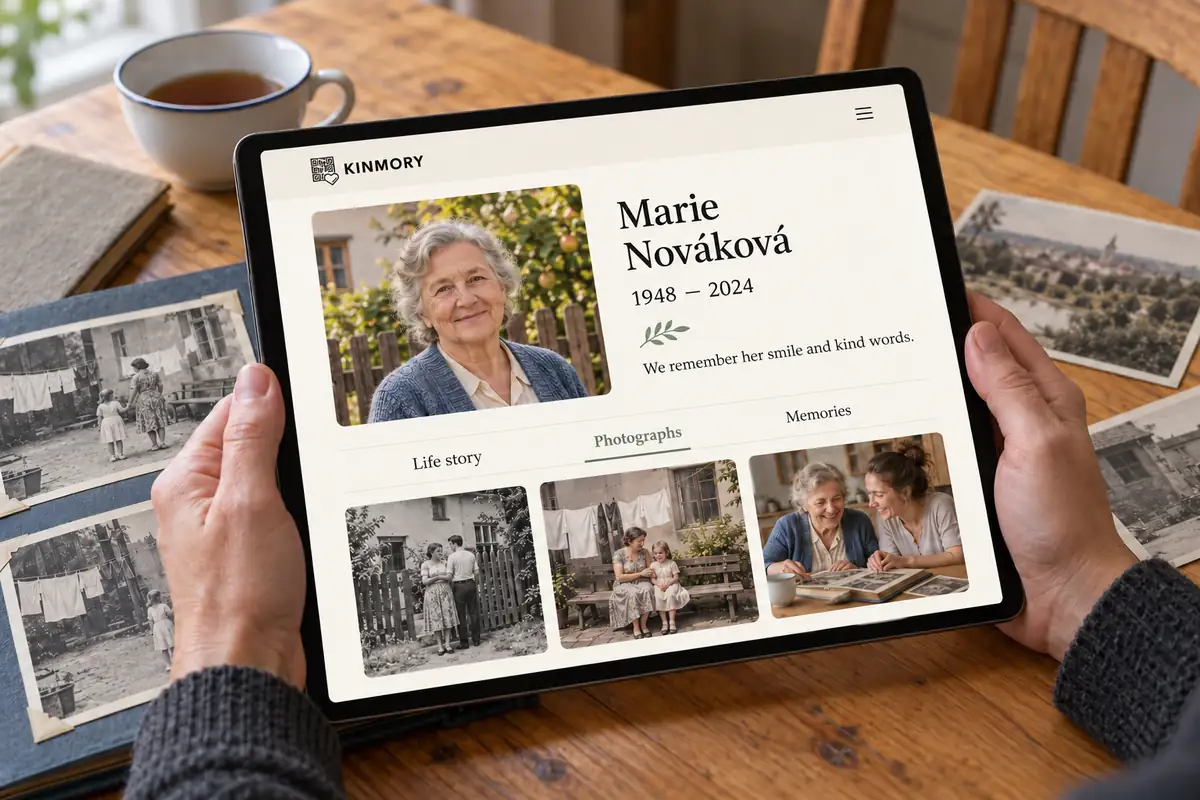
Kinmory helps you put together a memorial page for someone close: a portrait, photographs with captions, a life story and memories from people who knew them. The family chooses the page design and who sees it. A QR code can link the page with a memorial plaque. You can explore the options on the Kinmory home page.
We plan to extend the service with options to keep your own memorial page, create family photo albums and family trees, and write memoirs. That would let you gather in one place the memories of those close to you and your own story for your children and grandchildren.
Creating and designing the page
Start with a few photographs and one memory, perhaps of a shared trip or an ordinary day. You can preview the page before publishing.
Choose a design that matches how you remember the person, and add words of your own, such as a family saying or favourite verse. Agree with the family on the photographs and details to publish.
The page can also include a guest book, where relatives and friends can leave their own memories and add what they know about different periods of the person’s life. You decide whether to switch it on when you create the page.
Access and help from relatives
You decide who sees the page: it can be open, password-protected or limited to invited people. The closed mode is preselected when you create a page, and you can check the settings before publishing. Search engines may find an open page.
Open pages and password-protected pages are moderated before visitors can see them. The check is repeated after an edit and after switching to these modes, and the link and the QR code start working once it is finished.
After publishing, you can invite relatives by email or link. Adding to the page together depends on the plan, and each invited person uses their own account to view a closed page or to edit it. An accepted invitation stays valid, so give access only to people you trust. The author remains the owner, and invited people help within the permissions they have.
The QR code and the memorial plaque
A QR code links the page with a memorial plaque, for example on a headstone. After publishing, you can download the code as an image for preparing the plaque. The Kinmory team can give details of the options for making, ordering and receiving a plaque.
Before the plaque is made, ask for a trial print and scan its code with your phone. Keep the page address unchanged so the printed code still leads to the page, and wait for moderation to finish after any edit. Ask the cemetery administration whether it allows a code on a headstone. If you want visitors at the plaque to be able to open the page, choose the open mode or a password. A closed page is seen only by invited people who log in with their own account.
Adding to the story and keeping it
A page is created without a fixed time limit, and you can add photographs, captions and stories to it gradually. Keep the originals of photographs, captions and texts in the family archive too, in two independent places, so they can also be used for a printed album or a family history.
Photographs and text can be added to the page, while video, and adding to the page together with relatives, depend on the plan you choose. Keep voice recordings and documents in the family archive. You can put the page together and preview it before payment, which is made only at publication.
Find out more about memorial pages on the Kinmory website. Whether and when you use them is up to you and your family.
Frequently Asked Questions
What should I ask my grandparents when writing a family history?
Ask by theme: where your grandparents grew up, what their parents did for a living, how they met, what was cooked at home, how the family celebrated and who is in the old photographs. Ask about particular events rather than dates, and let them tell it in their own words. Record the conversation only with the storyteller’s consent.
Where can I find old Czech registers online, and who may inspect more recent entries?
Archives make digitised registers available, for example the State Regional Archives in Prague through eBadatelna (Central Bohemian Region, not the city of Prague) and the Moravian Land Archives in Brno through Acta Publica (the former South Moravian Region). The registry office lets the person concerned and their family members inspect more recent entries. Anyone else may do so once 100 years (births), 75 years (marriages and registered partnerships) or 30 years (deaths) have passed since the entry was made (zakonyprolidi.cz).
What should I consider before sharing a deceased relative’s photographs and letters?
Under Czech law, anyone close to the deceased may seek protection of the deceased’s personality rights, so agree with relatives first. Ask living people in photographs and letters for consent, since a likeness may generally be captured and shared only with consent. Private writings of a personal nature are protected to the same extent as records of private life (zakonyprolidi.cz). Also consider whether to publish sensitive details, such as the cause of death, illness, debts or family disputes.
How do I preserve a memorial page and family materials?
A memorial page on Kinmory is created without a fixed time limit, and you can add photographs and stories to it gradually. Keep the originals of photographs, captions and texts in the family archive as well, in two independent places. You will have them to hand when you want to print an album or put together a family history.
Who can see a memorial page?
On Kinmory you choose the open mode, password access or a closed mode for invited people with their own account. Open and password-protected pages are moderated, and the check is repeated after an edit and after switching to these modes. The link and the QR code start working once the check is finished. Search engines may find an open page.
Summary
Three steps are enough to begin, and none needs the internet:
- Label ten photographs: who is in them, where and roughly when.
- Write down one older relative’s story, with their consent.
- Agree who keeps the originals and who holds the second copy.
Then add to the archive at the family’s own pace. You do not have to publish anything.
Sources and Date of Information
- Act No. 132/2006 Coll., on Municipal Chronicles – the municipal chronicle (§ 1 and § 4).
- Act No. 301/2000 Coll., on Registers, Names and Surnames – keeping and inspecting registers (§ 8a, § 23, § 25, § 25b).
- Act No. 89/2012 Coll., the Civil Code – protection of personality (§ 82, § 84 to 87).
- Act No. 245/2000 Coll., on State Holidays, Other Holidays, Significant Days and Days of Rest – Den rodin as a significant day (§ 4).
- eBadatelna, Acta Publica (terms of use) and Porta fontium – digitised registers from individual regions.
- Ministry of the Interior: guide to the basics of registry law (2023) – the language of entries in old registers.
- Czech National Archive: Archival Processing of Photographic Records – storing and marking photographs in archives.
The team that runs this website provided the information about what Kinmory offers, valid as at 19 October 2026. Current options and ordering terms are on the service’s website and available from our team.
Information as at 20 October 2026. The laws are cited as in force on that date, and changes already published to take effect on 1 January 2027 do not affect the provisions this article relies on. Check the current wording in e-Sbírka, the official online Collection of Laws. Most sources are in Czech.
Related Articles
- How to cope with grief – the stages of grief.
- Dušičky: traditions and customs – remembering the deceased.
- Burial plot in the Czech Republic – lease and cost.
- How to write a will – valid forms.
- What to do with ashes after cremation – where ashes can be laid to rest.
- What a digital memorial is – what the term means.